
Bees, Wasps, and Yellow Jackets in Phoenix
TLDR: Phoenix is home to Africanized honey bees, several paper wasp species, and yellow jackets, all of which nest in and around residential areas. Knowing how to tell these stinging insects apart, understanding their behavior, and recognizing when a nest poses a danger are essential for staying safe in the Valley.
Why Are Stinging Insects So Common in Phoenix?
The Phoenix metropolitan area provides abundant resources for stinging insects: flowering desert plants and irrigated landscapes offer nectar and pollen, swimming pools and irrigation systems provide water, and residential structures offer countless sheltered nesting sites. The warm climate allows many species to remain active year-round, with colony sizes peaking during the warmer months.
While stinging insects play important ecological roles (pollinating plants, controlling pest insect populations, and serving as food for birds and other wildlife) their proximity to people creates legitimate safety concerns, particularly when Africanized honey bees are involved.
How to Identify the Three Main Stinging Insects in Phoenix
Africanized Honey Bees
Africanized honey bees (often called “killer bees”) are the dominant honey bee population in the Phoenix area. They are virtually identical in appearance to European honey bees, golden-brown with dark brown bands, approximately 12–15 mm long, and fuzzy-bodied. You cannot reliably distinguish Africanized bees from European bees by sight alone.
What makes Africanized bees distinct is their behavior. They are significantly more defensive of their nests than European honey bees, respond to disturbances faster, deploy more stinging defenders (potentially hundreds to thousands), and pursue perceived threats over longer distances, sometimes a quarter mile or more. Their venom is no more potent than that of European bees, but the sheer number of stings in a defensive response is what makes them dangerous.
Africanized bees nest in a wide variety of locations: hollow trees, wall voids, attics, irrigation valve boxes, overturned pots, old tires, sheds, and virtually any sheltered cavity. They also form temporary exposed swarm clusters on tree branches and structures while scout bees search for permanent nesting sites.
Important: If you encounter aggressive bee activity near your home, do not attempt to remove the nest yourself. Africanized bee removal requires professional expertise and protective equipment.
Paper Wasps
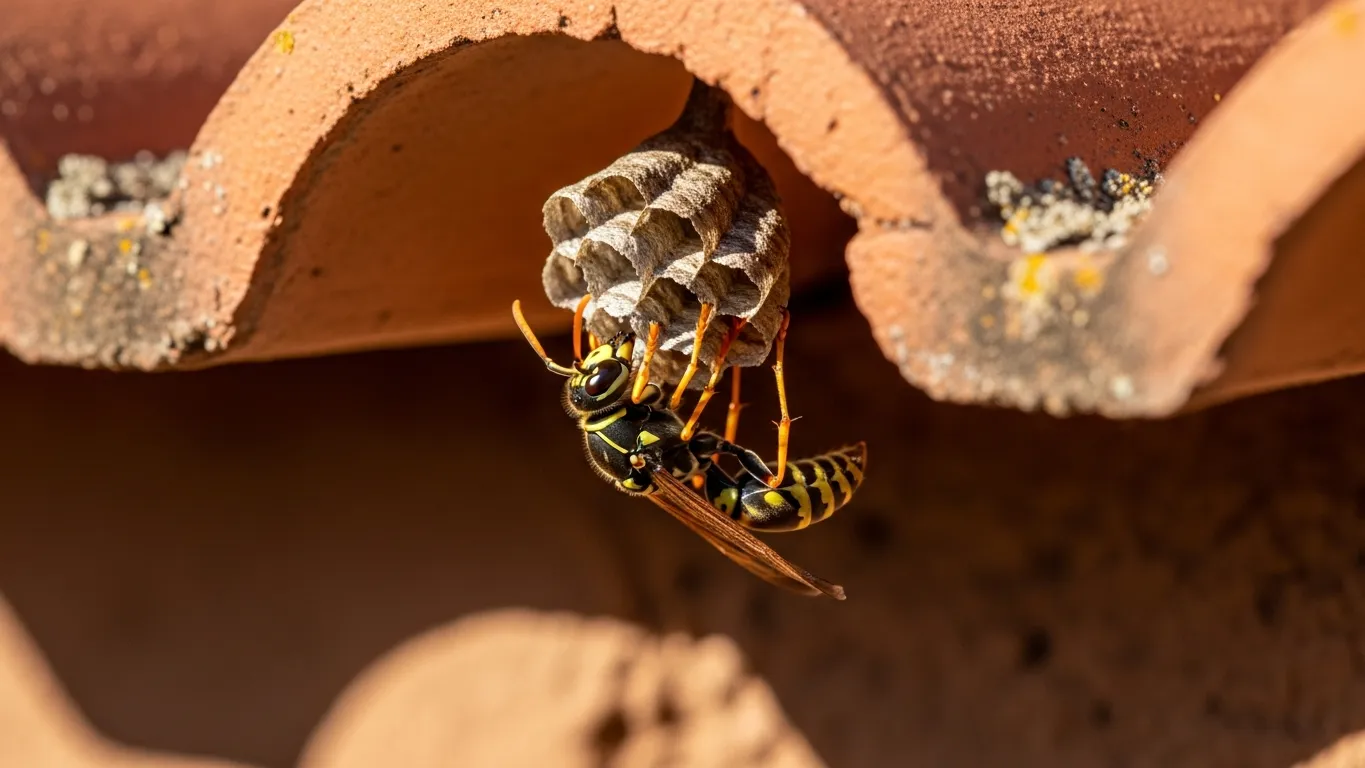
Paper wasps (Polistes spp.) are slender-bodied, 16–20 mm long, with long legs that dangle visibly during flight. In Phoenix, the most common species are brownish with yellow or reddish markings. Their flight pattern is slower and more meandering than that of bees or yellow jackets.
Paper wasps build distinctive open-celled nests that resemble an upside-down umbrella, a single comb of hexagonal cells attached to a surface by a thin stalk. Nests are typically found under eaves, porch ceilings, window frames, patio covers, and in outdoor light fixtures. A mature nest may contain 20 to 75 wasps.
Paper wasps are generally less aggressive than bees or yellow jackets unless their nest is directly threatened. They are beneficial predators, feeding caterpillars and other soft-bodied insects to their larvae. However, their tendency to build nests in high-traffic areas around homes makes human encounters common.
Yellow Jackets
Yellow jackets (Vespula spp.) are compact, 12–16 mm long, with a distinctly segmented, smooth (not fuzzy) body marked with bold black and yellow banding. They fly in fast, darting patterns and can be aggressive, especially near food sources.
Unlike paper wasps, yellow jackets typically nest in enclosed spaces, underground burrows (often in abandoned rodent holes), inside wall voids, and in hollow logs or landscape timbers. Nests are not visible from the outside. What you see is a steady stream of wasps entering and exiting a small opening. Yellow jacket colonies can grow large, containing 1,000 to 5,000 workers by late summer.
Yellow jackets are scavengers attracted to protein (meat, pet food) and sugary foods (fruit, soda, juice), making them common uninvited guests at outdoor meals. They become increasingly aggressive as colonies grow larger and food resources become scarce heading into fall.
How to Tell Bees and Wasps Apart at a Glance
| Feature | Honey Bees | Paper Wasps | Yellow Jackets | |—|—|—|—| | Body shape | Robust, fuzzy | Slender, smooth | Compact, smooth | | Color | Golden-brown | Brown with yellow/red | Bold black and yellow | | Flight style | Direct, purposeful | Slow, dangling legs | Fast, darting | | Nest type | Enclosed cavity with wax comb | Open umbrella-shaped comb | Enclosed underground or in voids | | Behavior near food | Focused on flowers | Occasional visitor | Aggressive scavenger |
What Should You Do If You Find a Nest?
- Keep your distance. Do not approach, poke, spray, or throw objects at a nest. Vibrations and sudden movements near a nest trigger defensive responses.
- Secure the area. Keep children, pets, and foot traffic away from the nest location.
- Do not seal the entrance. Blocking the opening of a bee or wasp nest traps the insects and can cause them to find or create an alternate entry, potentially into your living space.
- Call a professional. Nest removal (particularly for Africanized honey bees) is not a safe DIY project. Uni-Tech Pest Control handles stinging insect identification and removal throughout the Phoenix area. Call 602-962-8935 to report a nest.
How Can You Reduce Stinging Insect Activity Around Your Home?
- Seal cracks, gaps, and openings around your home’s exterior, especially around the roofline, eaves, and utility penetrations.
- Cover trash cans with tight-fitting lids and clean them regularly to remove food residue.
- Keep outdoor eating areas clean and cover food and drinks when dining outside.
- Inspect irrigation valve boxes, storage sheds, and unused equipment periodically for early-stage nests.
- Avoid wearing strong perfumes or brightly colored clothing when spending time near flowering plants, as these attract foraging bees.
Frequently Asked Questions
Are all bees in Phoenix Africanized?
Not all, but the majority of feral (wild) honey bee colonies in the Phoenix area carry Africanized genetics. Managed bee colonies maintained by beekeepers are typically European honey bees. Because the two cannot be distinguished visually, any unmanaged bee colony should be treated as potentially Africanized and approached with caution.
What should I do if bees are chasing me?
Run in a straight line toward the nearest enclosed shelter, a building or car. Pull your shirt over your head to protect your face if possible. Do not swat at the bees, jump into water, or hide in vegetation. Africanized bees will wait above water and continue stinging when you surface. Once inside a shelter, some bees may follow you in, but the number will be far smaller and manageable.
Can a single sting be dangerous?
For most people, a single sting causes localized pain, swelling, and redness that resolves within hours to days. However, roughly 2% of the population has a venom allergy that can trigger anaphylaxis, a life-threatening reaction involving difficulty breathing, swelling of the throat, rapid pulse, and dizziness. Anyone who has had a severe reaction to a sting should carry prescribed epinephrine (EpiPen) and seek emergency medical care immediately after being stung.
How do I know if a bee swarm is temporary or establishing a colony?
A swarm cluster (a visible ball of bees hanging from a branch, fence, or structure) is usually temporary, lasting a few hours to a few days while scout bees search for a permanent nesting location. If bees are entering and exiting a cavity (wall void, irrigation box, tree hollow), they have likely established a colony and will not leave on their own.