
How to Spot Subterranean Termites in Your Home
TLDR: Subterranean termites are the most destructive termite species in the Phoenix metro area. They build mud tubes to travel between their underground colonies and your home’s wood framing. Learning to recognize mud tubes, swarmers, and early damage signs helps you catch infestations before they become expensive problems.
There is a well-known saying among Phoenix homeowners: there are two types of houses in the Valley — those that have had termites and those that will. Subterranean termites are the reason that saying exists. They are the most common and most damaging termite species in the Phoenix metropolitan area, responsible for more structural repair costs than any other wood-destroying organism in Arizona. Knowing what to look for is the first step in protecting your property.
What Are Subterranean Termites?
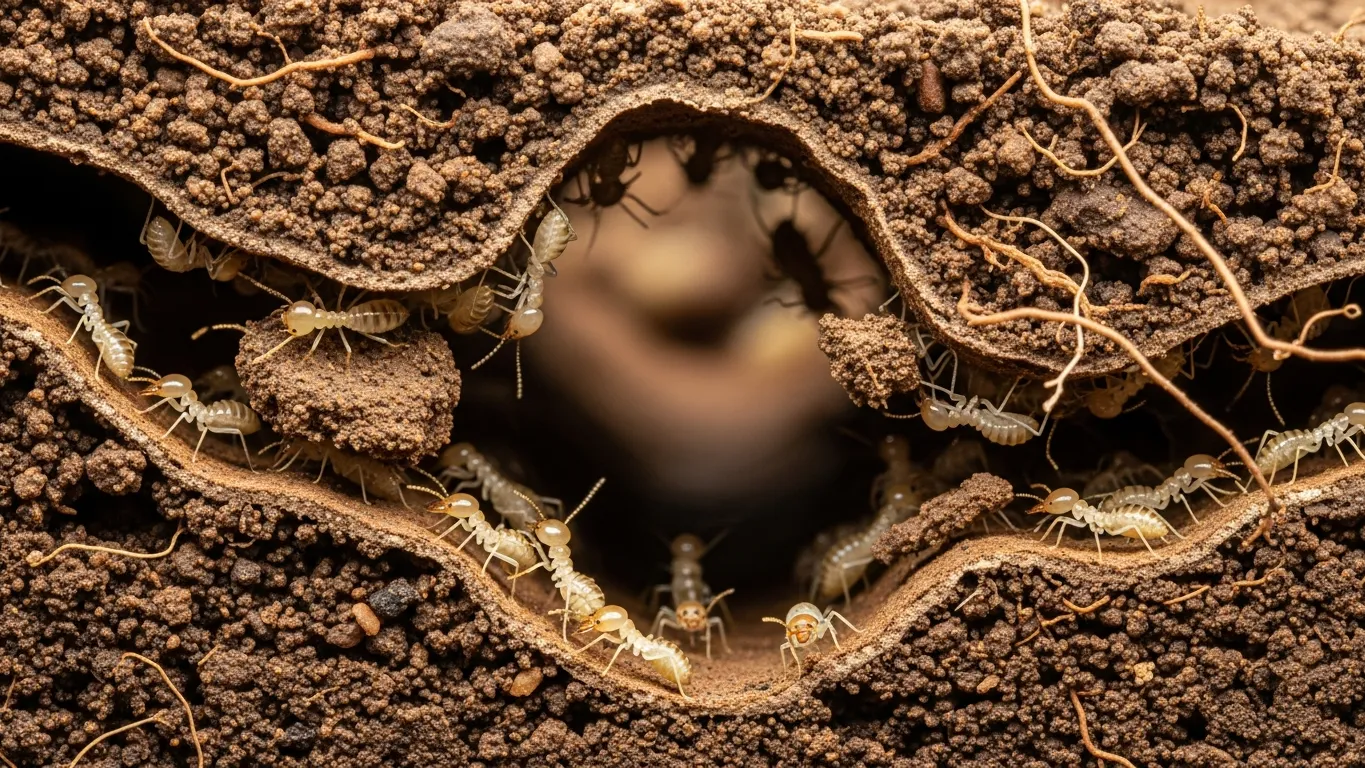
Subterranean termites are social insects that live in underground colonies, sometimes numbering in the hundreds of thousands. Unlike drywood termites, which live inside the wood they eat, subterranean termites maintain their colony in the soil and travel to above-ground food sources through a network of tunnels.
A colony contains three primary castes:
- Workers are small, soft-bodied, and creamy white. They are roughly the size of a grain of rice. Workers make up the vast majority of the colony and do all the feeding and tunnel construction. They are the caste that actually damages your home.
- Soldiers have enlarged, darker heads with prominent mandibles. Their sole function is colony defense. You may see soldiers when you break open an active mud tube or disturb infested wood.
- Swarmers (alates) are the reproductive caste. They are dark brown to black with two pairs of equal-length wings. Swarmers emerge from mature colonies to mate and establish new colonies, typically after rainfall in the Phoenix area.
The species most common in the Phoenix Valley is the desert subterranean termite (Heterotermes aureus). It is smaller than the eastern subterranean termite found in other parts of the country but is well adapted to Arizona’s arid soil conditions.
How to Identify Mud Tubes
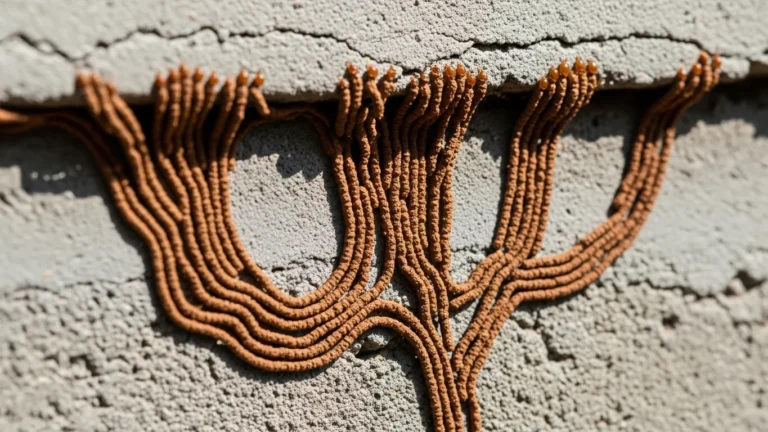
Mud tubes are the signature sign of subterranean termite activity and the feature that most often alerts Phoenix homeowners to an infestation. These tubes are constructed from soil, saliva, and fecal material, and they serve two purposes: they protect termites from predators and open air, and they maintain the humidity termites need to survive above ground.
Where to look for mud tubes:
- Exterior foundation walls — the most common location. Tubes typically run vertically from the soil line up the stem wall toward the sill plate or stucco weep screed.
- Interior garage foundations — the stem wall inside the garage is often left exposed and is a prime spot for visible tube construction.
- Expansion joints and plumbing penetrations — any gap where the slab meets a wall or where pipes pass through concrete is a potential entry point.
- Interior walls and ceilings — in more advanced infestations, tubes may appear as lines running up drywall or as narrow, dirt-colored strings hanging from the ceiling where termites have bridged a gap.
What mud tubes look like:
Mud tubes are roughly the width of a pencil, though they can be wider or narrower. They are brown to dark brown and have a gritty, soil-like texture. Fresh, active tubes are moist and may contain live termites if broken open. Old, abandoned tubes are dry and crumble easily.
Finding a mud tube does not always mean the infestation is active at that exact spot — termites may have moved to a different area. However, any mud tube warrants a full professional inspection because the colony is still present underground even if a particular tube has been vacated.
Recognizing Subterranean Termite Damage
Subterranean termite damage has a distinct pattern that differs from drywood termite damage:
- Damaged wood follows the grain. Subterranean termites consume the soft spring wood between the harder growth rings, leaving a layered or honeycombed pattern inside the wood. If you pull apart a damaged board, it will have a series of thin, parallel layers rather than being hollowed out smoothly.
- Mud and soil are present inside the wood. Unlike drywood termites, subterranean termites pack their galleries with soil and fecal material. If you break open infested wood and find dirt inside, subterranean termites are the likely culprit.
- Damage starts low and works upward. Because subterranean termites enter from the soil, damage typically begins at or near the foundation and progresses upward into wall studs, door frames, and window trim over time.
- Surface wood may appear intact. Termites feed from the inside out, leaving a paper-thin veneer of undamaged wood on the surface. A door frame or baseboard may look normal but sound hollow when tapped with a screwdriver handle.
In Phoenix homes, the most commonly damaged areas include bottom plates of walls (the horizontal framing member that sits on the slab), bathroom and kitchen framing where moisture is present, and garage-to-house partition walls.
How Quickly Do Subterranean Termites Cause Damage?
A common question after discovering mud tubes is how long the termites have been active. While there is no way to determine an exact timeline, some general guidelines apply. If tubes are found in only one or two isolated spots with no visible wood damage, the infestation is likely relatively recent. If tubes appear in multiple locations around the home or if probing reveals soft or damaged wood, the colony has been established longer and a thorough damage assessment is warranted.
A mature desert subterranean termite colony can consume several pounds of wood per year. Damage accumulates gradually, which is why annual professional inspections are the standard recommendation for Phoenix homes — catching activity early limits both structural harm and repair costs. Uni-Tech Pest Control provides termite inspections and treatment for homes throughout the Phoenix metro area.
Ready to get rid of termites? Call Uni-Tech Pest Control at (602) 962-8935 for a free inspection, or contact us online to schedule service.
Frequently Asked Questions
How often should I inspect my Phoenix home for subterranean termites?
An annual professional inspection is the minimum recommendation for homes in the Phoenix metro area. Homeowners should also do a quick visual check of exposed foundation walls and garage stem walls every few months, looking for new mud tubes. Properties with a history of termite activity or mature landscaping near the foundation may benefit from semi-annual professional inspections.
Can I remove mud tubes myself to see if termites come back?
You can wipe away a mud tube to monitor whether termites rebuild it, which indicates active foraging. However, removing the tube does not address the colony underground. If termites rebuild the tube — often within days — you have confirmed an active infestation that requires professional treatment. Even if they do not rebuild in that location, the colony may simply be entering elsewhere.
Are subterranean termites in Phoenix different from those in other states?
Yes. The dominant species in the Phoenix Valley is the desert subterranean termite (Heterotermes aureus), which is adapted to arid conditions and can forage in drier soil than the eastern subterranean termite common in humid states. Desert subterranean termites are smaller but form large colonies and are aggressive feeders. Treatment strategies effective in other regions may need adjustment for Arizona conditions.